More from the book 'Why Shrink a Cucumber: The complete guide to environmental packaging', showing through images the development of package design through the years and how they consider the change from width, height and diameter to make the packaging design more suitable. Brands shown include Heinz Tomato Ketchup and Toblerone.
What Is Design Ethics?
Design Ethics is where moral dilemmas are taken into action and decided upon. They are based on personal beliefs and values within society. External aspects need to be taken into consideration when designing for a client, and that the design should be suitable specifically for them. Designers need to keep various areas in mind, from environmental, multiculturalism to anti-consumerism etc.
Thursday, 1 May 2014
Sustainability in the design environment.
'Sustainable practices for graphic designers include a wide range of issues. When creating traditional print materials the toxicity of ink and paper and the sheer quantity of paper produced need to be considered. In addition to these factors there are other phases of the life cycle of products that need to be examined. To really determine the sustainability or carbon footprint of a product, one needs to follow it through its entire life cycle. Questions need to be raised about how much fuel is being used for shipping, what the final end product is, how long the life cycle is, and how long before the product ends up as waste.'
The carbon emissions created today from creating millions of pieces of design a year from print on paper to large installations. These pieces of design produced on a mass scale are greatly affecting the environment as stated above.
-
Connor
Branding
http://www.ethicsingraphicdesign.org/morality/branding/
link above talks about the power of branding and how much a brand can make a difference within the market. This links to previous posts about anti-consumerism.
Wednesday, 30 April 2014
Less is more
Another section from the book 'Why Shrink a Cucumber: The complete guide to environmental packaging', discussing how some of the best packaging are the simplest, and how companies use too much packaging on their products. Functions of packaging should be considered, and that reducing the content could be more suitable along with reducing the space around it.
Breakdown of Ethical Dilemmas in Packaging by Paula Fitzgerald Bone and Robert J. Corey
This research is all collected in the paper "Ethical Dilemmas in Packaging". Although the research on this essay is dated the examples it uses are still relevant today
According to the Natural Marketing Institute’s (NMI), Harleysville, PA, annual U.S. LOHAS Consumer Trends Study, a study performed in 2013. Over packaging is becoming a concern to consumers and more companies may have to look to sizing down their packaging sizes and use more greener products to attract new customers. (Article on the study)
Journal excerpts from: Green Purchasing Strategies: Trends and Implications by Hokey Min and William P. Galle
To help answer these questions, a survey questionnaire was developed for selected industry groups which are heavy producers of scrap and waste materials. These industries include chemicals (26.6 percent of the responding firms), food (12.3 per- cent), printing (9.8 percent), paper (9.2 percent), oil/gas extraction (6.7 percent), textiles (3.9 percent), furniture (3.9 percent), petroleum refineries (2.9 per- cent), lumber (2.5 percent), apparel (1.9 percent), and others (20 percent). From this sample, a total of 527 responses were received, a response rate of 17.6 per- cent.
Most of the respondents (84.4 percent) indicated that they have participated in some form of green purchasing initiative. As shown in Table I, the most important influences on supplier selection are potential liability, followed by cost associated with the disposal of hazardous material, and compliance with state and federal environmental regulations. The importance of the factors may stem from fear of liability litigation and fines and subsequent negative publicity.
Purchasing can enhance the effectiveness of a source reduction strategy in a number of ways such as:
- Reducing the purchased volume of items that are difficult to dispose of or are harmful to the ecosystem
- Reducing the use of hazardous virgin materials by purchasing a higher percentage of recycled or reused content
- Requiring that suppliers minimize unnecessary packaging and use more biodegradable or returnable packaging
In this study, respondents were asked to indicate the frequency of use of three strategies which could be used to reduce the sources of upstream waste. These results are shown in Table IIA.
Survey results indicate that 73.8 percent of the respondents either frequently or somewhat frequently use recycling for source reduction. This may be due in part to the more than 400 solid waste and recycling laws enacted by state governments in the United States.
Monday, 28 April 2014
Recyclable Packaging Design
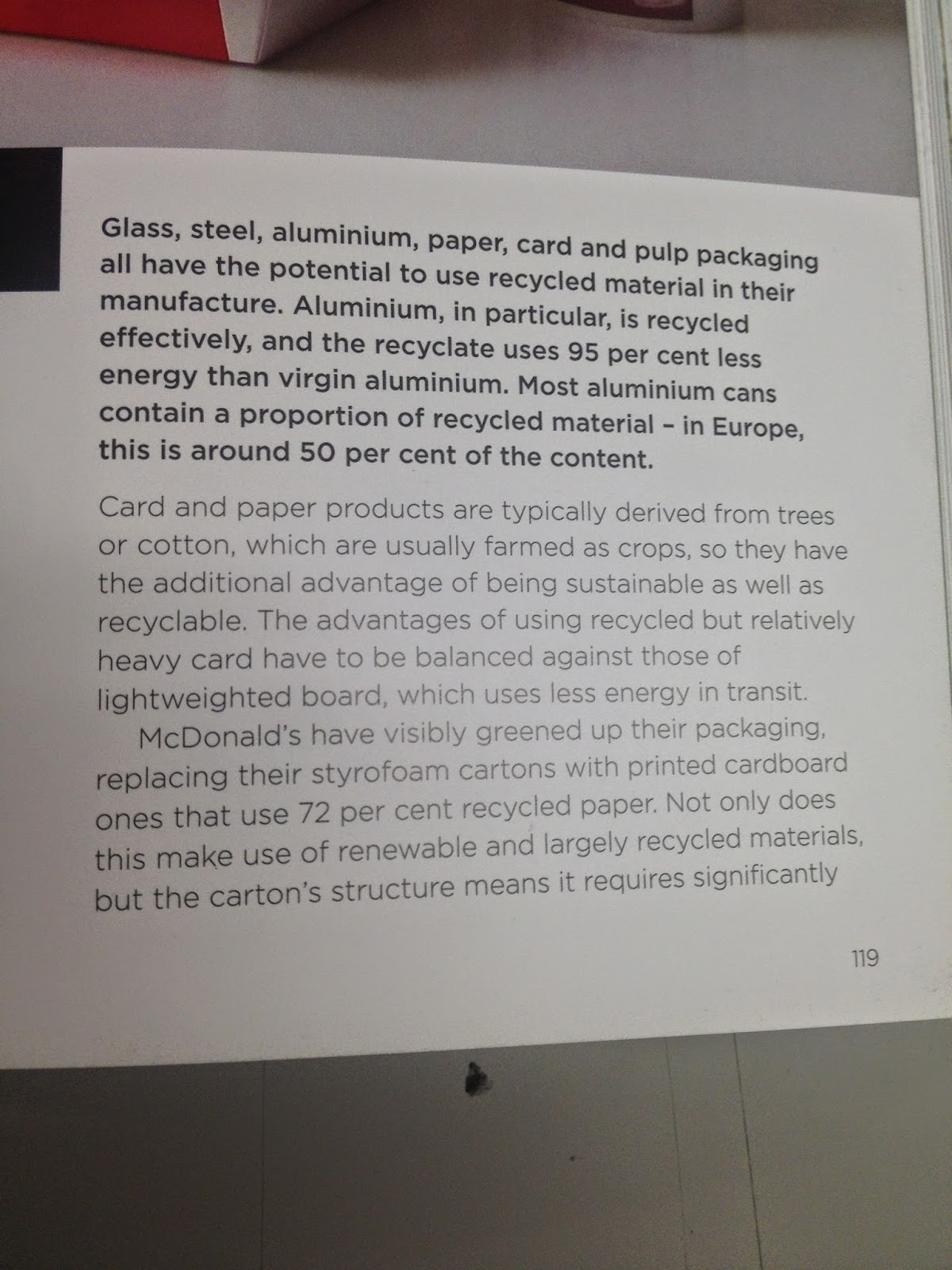
Within the book 'Why Shrink a Cucumber: The complete guide to environmental packaging', there are two double page spreads discussing the different packaging materials that can be recycled and how. I found that even McDonald's have improved their packaging to create it biodegradable, due to the fact that cards that come in contact with food cannot be recycled.
Subscribe to:
Posts (Atom)