What Is Design Ethics?

Design Ethics is where moral dilemmas are taken into action and decided upon. They are based on personal beliefs and values within society. External aspects need to be taken into consideration when designing for a client, and that the design should be suitable specifically for them. Designers need to keep various areas in mind, from environmental, multiculturalism to anti-consumerism etc.
Showing posts with label Environment. Show all posts

Monday, 5 May 2014

Green Beauty Products


Dr Bronner's beauty products uses 100% recycled plastic bottles for it's packaging.

Facial Highlighter by Juice Beauty
Juice Beauty, packaging made from recycled paper and dyed with soy ink.


John Masters Organics, outer packaging made with 100% recycled paper, printed with 100% soy ink and is biodegradable. 


Pangea oraganics packaging is 100% biodegradable, their brown plastic bottles are screen printed rather than using labels and their boxes are packaged with seeds inside the box so you can plant and grow them

Saturday, 3 May 2014


Ikea is a world wide known brand, in 2012 launched a sustainability strategy called People and Planet Positive (Ikea website link about it) it's aims are: to help others live a sustainable and environmentally friendly life, make the company resource and energy independent and to take the lead in creating a better life for people and communities. They also aimed to become 'forest positive' (article about it) (report on Ikeas environmentally friendly outlook). Huffington Post labelled Ikea the third most eco friendly company on the planet.

Friday, 2 May 2014

Watch Pornography - Save The Environment


Who knew pornography could be environmentally friendly? Oystermag.com have posted an article explaining how Pornhub now plant trees for every 100 views they get on their big penis category. Having organised 15,473 trees to be planted so far, they are currently deciding which environmental organisation to choose on their behalf. View the article here: Watch Porn - Save The Enviroment

Holland and Barrett


High street store Holland and Barrett are a green company who take on the responsibility of the environment. In doing this they supply herbal remedies for illnesses and supplements. For the environment, they are involved in waste, climate change, and have different initiatives.

Thursday, 1 May 2014

The story of bottled water

A video made discussing the difference between tap and bottled water, the ethical differences, and why people tend to purchase bottled water instead of using tap via the use of advertising.

Consider shape

More from the book 'Why Shrink a Cucumber: The complete guide to environmental packaging', showing through images the development of package design through the years and how they consider the change from width, height and diameter to make the packaging design more suitable. Brands shown include Heinz Tomato Ketchup and Toblerone.


Wednesday, 30 April 2014

Less is more

Another section from the book 'Why Shrink a Cucumber: The complete guide to environmental packaging', discussing how some of the best packaging are the simplest, and how companies use too much packaging on their products. Functions of packaging should be considered, and that reducing the content could be more suitable along with reducing the space around it.


Breakdown of Ethical Dilemmas in Packaging by Paula Fitzgerald Bone and Robert J. Corey


This research is all collected in the paper "Ethical Dilemmas in Packaging". Although the research on this essay is dated the examples it uses are still relevant today

According to the Natural Marketing Institute’s (NMI), Harleysville, PA, annual U.S. LOHAS Consumer Trends Study, a study performed in 2013. Over packaging is becoming a concern to consumers and more companies may have to look to sizing down their packaging sizes and use more greener products to attract new customers. (Article on the study)


Journal excerpts from: Green Purchasing Strategies: Trends and Implications by Hokey Min and William P. Galle


To help answer these questions, a survey questionnaire was developed for selected industry groups which are heavy producers of scrap and waste materials. These industries include chemicals (26.6 percent of the responding firms), food (12.3 per- cent), printing (9.8 percent), paper (9.2 percent), oil/gas extraction (6.7 percent), textiles (3.9 percent), furniture (3.9 percent), petroleum refineries (2.9 per- cent), lumber (2.5 percent), apparel (1.9 percent), and others (20 percent). From this sample, a total of 527 responses were received, a response rate of 17.6 per- cent. 
Most of the respondents (84.4 percent) indicated that they have participated in some form of green purchasing initiative. As shown in Table I, the most important influences on supplier selection are potential liability, followed by cost associated with the disposal of hazardous material, and compliance with state and federal environmental regulations. The importance of the factors may stem from fear of liability litigation and fines and subsequent negative publicity.
 Purchasing can enhance the effectiveness of a source reduction strategy in a number of ways such as: 
  1. Reducing the purchased volume of items that are difficult to dispose of or are harmful to the ecosystem 
  2. Reducing the use of hazardous virgin materials by purchasing a higher percentage of recycled or reused content 
  3. Requiring that suppliers minimize unnecessary packaging and use more biodegradable or returnable packaging
    In this study, respondents were asked to indicate the frequency of use of three strategies which could be used to reduce the sources of upstream waste. These results are shown in Table IIA.
Survey results indicate that 73.8 percent of the respondents either frequently or somewhat frequently use recycling for source reduction. This may be due in part to the more than 400 solid waste and recycling laws enacted by state governments in the United States.

Monday, 28 April 2014

Recyclable Packaging Design

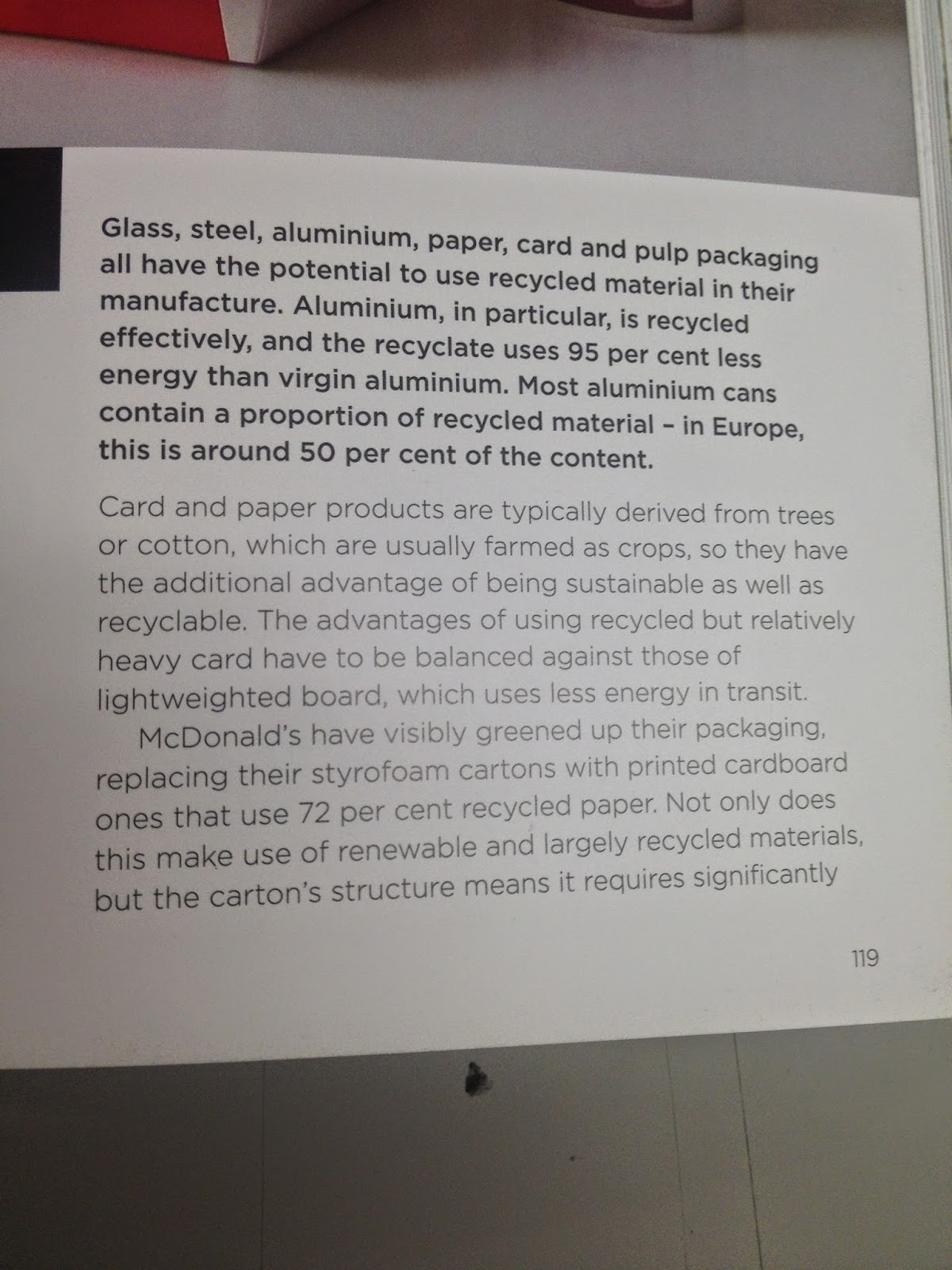
Within the book 'Why Shrink a Cucumber: The complete guide to environmental packaging', there are two double page spreads discussing the different packaging materials that can be recycled and how. I found that even McDonald's have improved their packaging to create it biodegradable, due to the fact that cards that come in contact with food cannot be recycled.


Tuesday, 11 March 2014

Environmental Packaging within Design

Global Warning and the environment play a large part within design, how much is too much? Is there more packaging then needed, creating more waste. I researched into the book 'Why Shrink a Cucumber: The complete guide to environmental packaging' to have an insight on how package design may affect the environment and in what ways could solve the issue. Inside there was a double page spread discussing the issues of how packaging may effect the environment, along with other polluters.


I also found a page discussing whether designers should boycott clients that overuse packaging where it is not needed. Moralities of designers are mentioned, explaining how many refuse to design for cigarette or alcohol manufactorers.