
Showing posts with label Bethany. Show all posts
Showing posts with label Bethany. Show all posts
Friday, 2 May 2014
Food Not Bombs Movement

Barbara Kruger: I Shop Therefore I Am

UNTITLED (I SHOP THEREFORE IAM),1987.
One of Kruger's well known pieces showing how what we purchase is what defines us. Providing ourselves with our own label.
Watch Pornography - Save The Environment

Who knew pornography could be environmentally friendly? Oystermag.com have posted an article explaining how Pornhub now plant trees for every 100 views they get on their big penis category. Having organised 15,473 trees to be planted so far, they are currently deciding which environmental organisation to choose on their behalf. View the article here: Watch Porn - Save The Enviroment
Holland and Barrett

High street store Holland and Barrett are a green company who take on the responsibility of the environment. In doing this they supply herbal remedies for illnesses and supplements. For the environment, they are involved in waste, climate change, and have different initiatives.
Freegans
Freegans are an anti consumist group that practise in waste reclamation and waste minimalization. They force these into action by dumpster diving and urban foraging, where they recover usable items that have been needlessly discarded. They also hold events where you can swap goods, such as food, and presents. They promote websites such as freecycle where the public can advertise anything for free, with no purchase.
Thursday, 1 May 2014
Consumerism & Anti-consumerism in Popular Culture
A song exposing the effects of consumerism in contemporary society focusing on the Nike corporation & their range of footwear.
In this video singer and rapper, Macklemore talks about the importance of consumerist brands, specifically Nike, to a child's feelings of acceptance & worthiness. Macklemore talks about how his friends couldn't afford a pair of shoes like his Nike Air Max's (one of the best brands) so they wore Adidas trainers (a brand not regarded with the same status as Nike.) He describes how, although he wasn't the best at basketball, compared to all of his friends he had the best and most professional trainers.
Macklemore presents the incredible negativity and violence caused by consumerism in the lyric "my friend Carlos' brother got murdered for his fours" referring to Nike Air Jordan IV's and how this boy was murdered by people who wanted these shoes but could not afford them, therefore resorting to assault and theft. Consumerism emphasises class consciousness and segregates people into a class system hierarchy. You can afford to wear Nike trainers, therefore you are worth something. You cannot afford Nike trainers, therefore you are not worth anything. Although it is not always as black and white as just described, this is ultimately what Macklemore is trying to emphasise.
Through his final words "consumption is in the veins, and now I see it's just another pair of shoes." Macklemore comes to the realisation that consumerism has become a part of everyday life and has enabled people value the worth of others through what they wear, and ultimately what they can afford to buy. The lyrics in the song "I bought these dreams, that all fall down" emphasise that having material items isn't always going to make you happy, sometimes it actually causes you more difficulty and struggle.
Although he makes a very good point through his lyrics, the music video completely contradicts the song, throughout showing young boys wearing a range of Nike shoes, and also groups of people sat in front of a shop with the Nike slogan "Just Do It." Although this is not necessarily presenting the brand in a positive light, it is still featured in a pop song which has been watched by nearly 50million viewers.
The story of bottled water
A video made discussing the difference between tap and bottled water, the ethical differences, and why people tend to purchase bottled water instead of using tap via the use of advertising.
Buy Nothing Day

It's time to lock up your wallets and purses, cut up your credit cards and dump the love of your life - shopping.
Saturday November 29th 2014 is Buy Nothing Day (UK). It's a day where you challenge yourself, your family and friends to switch off from shopping and tune into life. The rules are simple, for 24 hours you will detox from shopping and anyone can take part provided they spend a day without spending!
Everything we buy has an impact on the environment, Buy Nothing Day highlights the environmental and ethical consequences of consumerism. The developed countries - only 20% of the world population are consuming over 80% of the earth's natural resources, causing a disproportionate level of environmental damage, and an unfair distribution of wealth.
One day a year is dedicated to stop purchasing goods and focus on reality, changing your lifestyle for just one day. The day makes you question what you buy and to challenge the companies who produce them. Consuming less is for the better and by taking part in this day is a great way to start it.
Burger and French Fries DIY Packet
A video showing how to make fast food from powder. The packaging is used during the process of creating the food and a part of the overall finished product, making it useful and not wasted.
Consider shape
More from the book 'Why Shrink a Cucumber: The complete guide to environmental packaging', showing through images the development of package design through the years and how they consider the change from width, height and diameter to make the packaging design more suitable. Brands shown include Heinz Tomato Ketchup and Toblerone.


Wednesday, 30 April 2014
Less is more
Another section from the book 'Why Shrink a Cucumber: The complete guide to environmental packaging', discussing how some of the best packaging are the simplest, and how companies use too much packaging on their products. Functions of packaging should be considered, and that reducing the content could be more suitable along with reducing the space around it.


Monday, 28 April 2014
Recyclable Packaging Design
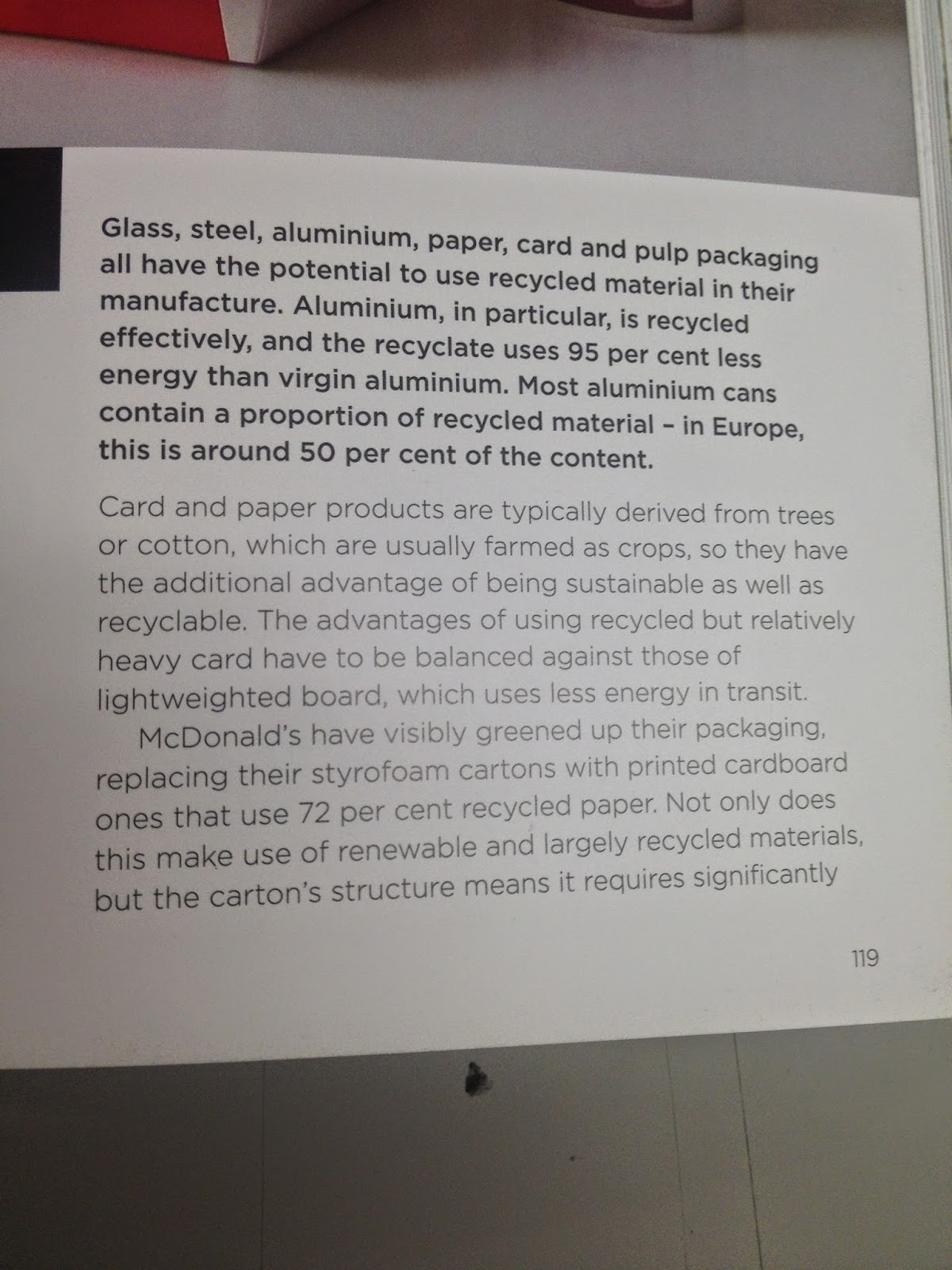
Within the book 'Why Shrink a Cucumber: The complete guide to environmental packaging', there are two double page spreads discussing the different packaging materials that can be recycled and how. I found that even McDonald's have improved their packaging to create it biodegradable, due to the fact that cards that come in contact with food cannot be recycled.



Wednesday, 23 April 2014
'The Greatest Movie Ever Sold'
'The Greatest Movie Ever Sold' is a 2011 film directed by Morgan Spurlock discussing product placement within everyday media, specifically through the medium of film. This film (Which was funded through Advertising) examines how we constantly consume advertisements everywhere and how brands can be instantly recognisable.
Sunday, 20 April 2014
No Logo


There's a bad mood rising against the corporate brands. No Logo is the warning on the label.
First published in 1999, No Logo by Naomi Klein gives an analysis of our branded world. It specifies on the corporate takeover, by well known brands such as Nike, Gap and Chanel, and how they brand our lifestyles with a simple logo.
Thursday, 17 April 2014
Biotic Baking Brigade Found Footage
Whilst researching further into BBB, I discovered footage online of the activists throwing a few pies at Mayor Willie Brown in 1998 during a 'Clean-Up' event in Bayview/Hunter's Point.
Anti-Consumerists: Biotic Baking Brigade
Biotic Baking Brigade are a network of bakers who pie the faces of public figures. They stand for ecology, human-scale economies, bioregionalism and proper gastronomics. Famous victims of their attacks include Bill Gates and many US city mayors,

"Pieing doesn’t replace other forms of action, but it is a creative tool in a toolbox of resistance to corporate crime. People are sick to death of writing letters, voting, complaining and just being ignored."
Sunday, 13 April 2014


Friday, 11 April 2014
More from Adbusters, Corporate Crackdown
How much damage does a company have to do before we question its existence?


Tuesday, 1 April 2014
Adbusters, the anti-consumerist organization

Wednesday, 26 March 2014
Ethical Choice in the Fashion Industry
When looking into ethical choice concerning industry, I wanted to obtain some primary research from someone with first-hand experience. I asked Fashion Designer, Francesca Gasporini, what it is like to work for a large corporation within an industry often associated with making their products through unethical means. This is what she had to say about the matter,
“Factories can be very evasive in how they present themselves to external visitors, what you see is not always what you get. From my own experience of visiting these factories in locations such as Italy and Portugal I have found that workers often have to hide certain conditions or aspects of the factory from paying clients; so it wouldn’t surprise me if factories such as these have young children working for them. However there are other aspects to think about in the situation, such as some children are the only members of their family's able to work, therefore the family's only source of income comes from this child. I am not supporting illegal child labour, however China has a completely different set of values from the United Kingdom; at one time it was socially accepted for children to work in similar factories in this country. I have worked for many prestigious fashion brands who spend more money on their factories, which makes it less likely that they have children on their staff. Where I work at the moment, the company owns their own factory, meaning if they did have children illegally working for them, the company itself would get in trouble. If I knew I was working for a company that hired young children as labourers, I don’t think I would feel comfortable working there. I would never apply for a job with a company I knew used child labourers to construct their designs.”
It is interesting to get a different, and first hand perspective of an individual who has experienced what it is genuinely like in places of ethical ambivalence, these places make you question what is right and wrong in this industry. However I also found it really interesting that Gasporini mentions the workers from a different perspective, not as a child labourer, but as a family member putting food on the table; what if this child isn’t being forced to work, what if they are working to provide for their family?
Subscribe to:
Posts (Atom)