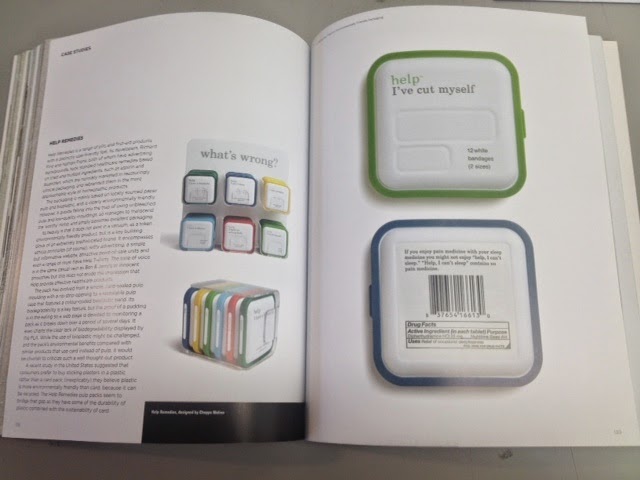
A section in 'Why Shrink a Cucumber: The complete guide to environmental packaging' showing the change of design within packaging and how it keeps upto date with modern packaging design. Varying from Coca-Cola lightweight glass bottles, Nobottle, help remedies, Ecoclean, headphones and Boots reading glasses.
What Is Design Ethics?
Design Ethics is where moral dilemmas are taken into action and decided upon. They are based on personal beliefs and values within society. External aspects need to be taken into consideration when designing for a client, and that the design should be suitable specifically for them. Designers need to keep various areas in mind, from environmental, multiculturalism to anti-consumerism etc.
Thursday, 1 May 2014
Ethical Responsibility
Working together with clients can be tough getting your ideas across and to keep them ethically responsible for all parties involved. As a designer myself ethical pieces of work are always a priority especially pieces of work such as posters and flyers that are going to be produced by the thousands.
Graphic design is built upon relationships—relationships between the designer and the client as well as the designer and other members of the design team. Creative directors, illustrators, photographers, art directors, videographers, programmers, developers, copywriters, copy editors, project managers, and graphic designers are all collaborators in determining the success of a project. Not all projects require all roles and these roles often overlap or are filled by the same person, the designer. The most successful projects happen when there is a bond of trust between the client and the designer. The most effective way to assure that the expectations of all the parties is met is to validate the relationship with a written agreement.
Green Washing
GREENWASHING - One of the biggest challenges that graphic designers face is educating their clients about sustainable practices. When companies claim to be ecofriendly based on a myopic view of sustainability and without looking at all the implications of their actions, they may end up being guilty of greenwashing—the practice of “spinning” their products and policies as environmentally friendly, such as by presenting cost cuts as reductions in use of resources. Sustainable practices need to be authentic. If they are not, they lose all credibility.
Green washing happens more than a lot of the large companies would like to admit, although some may be true there are different areas of which they are not so 'ecofriendly'. By spinning the companies final image the are seriously at risk to false advertisement claims and losing a customer base.
Eco Friendly Packaging
http://products.londonbiopackaging.com/en-us/contentlanding/category+list+landing/compostable-and-recycled-packaging.aspx?gclid=CNb91qPWir4CFSf4wgodal8AGg
The link above shows a company that focus entirely on making eco friendly packaging for all sorts of things so that companies can buy them to package their goods in.
I think this website is a great idea, and the website is easy to use too.
All about sustainability and recycling whilst still making quality products.
Consider shape
More from the book 'Why Shrink a Cucumber: The complete guide to environmental packaging', showing through images the development of package design through the years and how they consider the change from width, height and diameter to make the packaging design more suitable. Brands shown include Heinz Tomato Ketchup and Toblerone.
Sustainability in the design environment.
'Sustainable practices for graphic designers include a wide range of issues. When creating traditional print materials the toxicity of ink and paper and the sheer quantity of paper produced need to be considered. In addition to these factors there are other phases of the life cycle of products that need to be examined. To really determine the sustainability or carbon footprint of a product, one needs to follow it through its entire life cycle. Questions need to be raised about how much fuel is being used for shipping, what the final end product is, how long the life cycle is, and how long before the product ends up as waste.'
The carbon emissions created today from creating millions of pieces of design a year from print on paper to large installations. These pieces of design produced on a mass scale are greatly affecting the environment as stated above.
-
Connor
Branding
http://www.ethicsingraphicdesign.org/morality/branding/
link above talks about the power of branding and how much a brand can make a difference within the market. This links to previous posts about anti-consumerism.
Subscribe to:
Posts (Atom)